

Different modes of CGRP blockade in migraine therapy: CGRP pathway monoclonal antibodies vs. oral gepants
Targeting the calcitonin-gene related pathway (CGRP): Monoclonal antibodies (mAbs) vs. oral gepants
Migraine is a common neurological disorder with a complex pathophysiology characterized by attacks of disabling headache.1 Over the past decades, advancements in migraine research and migraine therapy have led to the discovery of novel preventive therapies for migraine.2
THE ROLE OF CGRP IN MIGRAINE
CGRP is a pain-related neuropeptide that is elevated in migraine and thus, is a key neurotransmitter in migraine pathophysiology.3 CGRP receptors are widely distributed at all sites involved in migraine pathogenesis, and blocking them has been shown to prevent or reduce the incidence of migraine attacks.3 Thorough characterization and identification of CGRP receptors has led to the development of drugs such as oral gepants and CGRP pathway mAbs that can block the receptor and ligand with the aim to treat or prevent migraine in patients.
CGRP PATHWAY MABS VS. ORAL GEPANTS: EXAMINING THE DISTINCT PHARMACOKINETICS
Gepants are small molecule CGRP receptor antagonists that have an extremely high binding affinity to CGRP receptors in humans.4 The size of the gepants is in the order of 0.2–1 kDa,5 which allows them to partially cross the blood–brain barrier (BBB) and potentially affect the central nervous system (CNS).6
Over 15 years ago, the development of first generation gepants was discontinued due to liver toxicity concerns.1 Since then, four second generation gepants have been developed: Rimegepant, ubrogepant and atogepant, which have been approved by the Food and Drug Administration (FDA) for the acute therapy of migraine,7-9 and vazegepant, which is in Phase 2/3 clinical development.10,11
In parallel to the advancement of gepants in blocking CGRP receptors, four mAbs that target either the CGRP receptor or ligand have been developed.6 The mAbs targeting the CGRP ligand are fremanezumab, galcanezumab, and eptinezumab, while the mAb targeting the CGRP receptor is erenumab5—all are FDA approved.12-15
In comparison to gepants, CGRP pathway mAbs are larger, in the order of 150 kDa,5 and as such, have limited potential to cross the BBB and therefore are not considered to impact the CNS.6
FINDING THE OPTIMAL DOSING SCHEDULE: ORAL VS. INJECTABLE, ACUTE VS. PREVENTIVE
Each CGRP pathway therapy has its distinct dosing schedule.16 For example, CGRP pathway mAbs, which are used for the preventive treatment of migraine, are administered via injection once a month or less frequently.12-15 Oral gepants, instead, are available in pill form or as orally disintegrating tablets, which can be taken either for the acute (ubrogepant and rimegepant)7,8 or preventive (rimegepant and atogepant)7,9 treatment of migraine. The availability of dosing options in CGRP pathway mAbs therapy allows patients with migraine to have flexibility in deciding to which therapy to adhere.17 As one of the key factors in successful therapy of migraine is adherence,17 a variety of dosing schedules and distinct methods of drug delivery can cater to a wider range of patient needs and lifestyles.17

Examining the efficacy of CGRP pathway therapies
Monthly migraine days (MMDs) as a primary outcome measure
The primary outcome measure for all clinical trials evaluating CGRP pathway mAbs was an assessment of the mean change from baseline in MMDs between patients receiving CGRP pathway mAbs and patients receiving placebo; the proportion of patients achieving at least a 50% reduction in the mean number of MMDs from baseline was the secondary efficacy endpoint.18 Focusing on the primary outcome measure, efficacy results collected across all clinical trials demonstrated that, in comparison to patients with episodic migraine (EM) receiving placebo, patients with EM being treated with any of the four CGRP pathway mAbs in various doses had significant reductions in MMDs ranging from 0.69 to 1.9 days.19-22 In comparison, patients with chronic migraine (CM) reported an overall reduction ranging from 1.8 to 2.6 MMDs after receiving any of the available CGRP pathway mAbs in different doses compared to placebo.23-26
Using the 50% responder rate to assess clinical response
Regarding the secondary outcome measure in a clinical trial, a clinical response to migraine therapy has been defined as at least a 50% reduction in mean migraine days per month.27 Overall, the absolute difference in the percentage of patients with EM receiving one of the four CGRP pathway mAbs in various doses and achieving a 50% reduction in their MMDs varied from 12.4% to 23.4% when compared to patients with placebo.19-22 As for patients with CM, therapy with any of the four CGRP pathway mAbs in different doses resulted in 18% to 23% more patients reaching a 50% reduction in their MMDs when compared to patients with placebo.23-26 Significant reductions in the number of migraine days per month when compared with the placebo group corroborates the clinical benefit of these CGRP pathway mAbs.18

RIMEGEPANT: THE FIRST ORAL GEPANT FOR THE PREVENTIVE THERAPY OF MIGRAINE?
Atogepant, rimegepant and ubrogepant were all shown to be more effective than placebo based on results obtained from clinical trials.28-32 A twelve-week treatment with atogepant, which is indicated for the preventive treatment of episodic migraine in adults,9 led to a significant reduction in MMDs, ranging from 3.7 to 4.2.30-32 For rimegepant and ubrogepant, which are both approved for acute migraine treatment,7,8 the primary endpoints were freedom from pain and freedom from the most bothersome symptoms, both at 2 hours post-dose.33 A single 75-mg dose of rimegepant was significantly more effective than placebo for maintaining freedom from pain (21% vs. 11% in placebo) and the most bothersome symptoms (35% vs. 27% in placebo) 2 hours post-dose.28 Similarly, the number of patients who experienced freedom from pain (21.2% vs. 11.8% in placebo) and absence of the most bothersome migraine-associated symptoms (37.7% vs. 27.8% in placebo) was higher among patients receiving 100 mg of ubrogepant than among those who received a placebo.29
Evaluating safety measures in CGRP pathway therapies
SAFETY OF CGRP PATHWAY MONOCLONAL ANTIBODIES
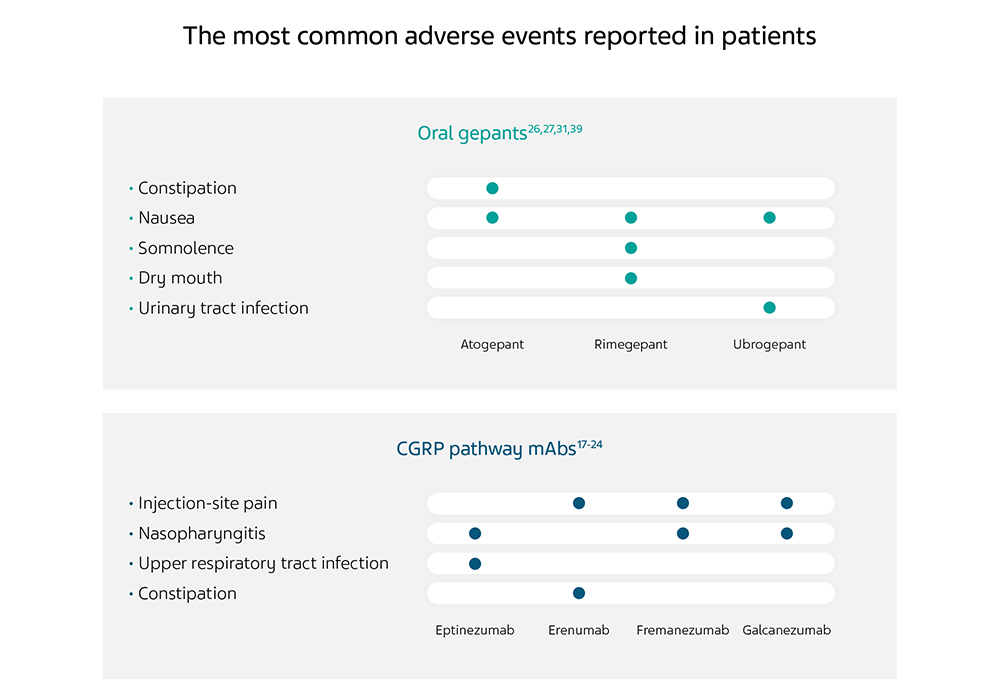
When it comes to the safety of CGRP pathway mAbs, AE data collected from clinical trials generally suggests a favorable risk-benefit profile.19-26 Furthermore, AE-related discontinuation rates remained low as most AEs were mild to moderate in severity.19-26 Current data have noted the absence of specific maternal toxicities in pregnant and lactating women after exposure to CGRP pathway mAbs.34 Nevertheless, continuous monitoring is required to further validate the safety of these treatments in pregnancy.34 In this regard, several Pregnancy Exposure Registries—studies gathering health information on exposure to treatments and vaccines during pregnancy—35 are currently ongoing and collecting data on the use of CGRP pathway mAbs on pregnant women.36-38
SAFETY OF ORAL GEPANTS
The terminated development of first generation gepants due to concerns of liver toxicity1 has meant that both ubrogepant and rimegepant, as second generation therapies, have been studied extensively for signs of liver problems across all phases of clinical trials.28,29 Until now, both drugs, along with atogepant—approved in 2021—9do not show any indication of liver toxicity issues that occurred in the first generation gepants.28,29,31 For atogepant, the most common AEs were constipation and nausea, which were reported by 7–8% and 3–9% of patients, respectively.31,39 The most common side effects for ubrogepant were nausea, somnolence and dry mouth, with the frequency of events being similar to placebo.29 In one large randomized trial, no patients discontinued ubrogepant due to an AE.29 As for patients treated with rimegepant, the only side effects observed were nausea and urinary tract infection, seen in 1% more patients when compared with placebo.28
AN ENCOURAGING FUTURE FOR PATIENTS WITH MIGRAINE
Oral gepants and CGRP pathway mAbs use different approaches to reach the same goal: blocking CGRP to counteract migraine.40 Thanks to a better understanding of migraine pathophysiology, the development of migraine treatments has increased significantly since 2018, leading to a wide array of therapeutic alternatives.40 Despite the fact that more long-term data are needed, the possibility of relying on multiple available acute and preventive treatments is encouraging for the future of patients with migraine.
Goadsby PJ, Holland PR, Martins-Oliveira M, Hoffmann J, Schankin C, Akerman S. Pathophysiology of Migraine: A Disorder of Sensory Processing. Physiol Rev 2017;97:553-622.
Do TP, Guo S, Ashina M. Therapeutic novelties in migraine: new drugs, new hope? The Journal of Headache and Pain 2019;20:37.
Benarroch EE. CGRP: sensory neuropeptide with multiple neurologic implications. Neurology 2011;77:281-7.
Negro A, Lionetto L, Simmaco M, Martelletti P. CGRP receptor antagonists: an expanding drug class for acute migraine? Expert Opin Investig Drugs 2012;21:807-18.
Tepper SJ. History and Review of anti-Calcitonin Gene-Related Peptide (CGRP) Therapies: From Translational Research to Treatment. Headache 2018;58:238-75.
Edvinsson L. CGRP receptor antagonists and antibodies against CGRP and its receptor in migraine treatment. Br J Clin Pharmacol 2015;80:193-9.
NURTEC ODT (rimegepant). Highlights of Prescribing Information. Biohaven Pharmaceuticals. Update May 2021.
UBRELVY (ubrogepant). Highlights of Prescribing Information. Allergan. Updated December 2019.
QULIPTA® (atogepant). Highlights of Prescribing Information. Allergan Pharmaceuticals International Limited, an AbbVie company. Updated September 2021.
A Study to Evaluate the Efficacy and Safety of Oral Zavegepant in Migraine Prevention. ClinicalTrials.gov identifier: NCT04804033. Updated: 30 March 2021. Accessed: 11 January 2022. https://clinicaltrials.gov/ct2/show/NCT04804033.
Long-term Safety Study of BHV-3500 (Zavegepant*) for the Acute Treatment of Migraine. ClinicalTrials.gov identifier: NCT04408794. Updated: 15 December 2021. Accessed: 11 January 2021. https://clinicaltrials.gov/ct2/show/NCT04408794.
AIMOVIG® (erenumab-aooe). Highlights of Prescribing Information. Novartis Pharmaceutical Corporation. Updated April 2020.
AJOVY® (fremanezumab-vfrm). Highlights of Prescribing Information. Teva Pharmaceutical Industries. Updated January 2020.
EMGALITY® (galcanezumab-gnlm). Highlights of Prescribing Information. Eli Lilly and Company. Updated December 2019.
VYEPTI® (eptinemzumab-jjmr). Highlights of Prescribing Information. Lundbeck Seattle BioPharmaceuticals. Updated February 2020.
Mitsikostas DD, Belesioti I, Arvaniti C, et al. Patients' preferences for headache acute and preventive treatment. J Headache Pain 2017;18:102.
Cowan R, Cohen JM, Rosenman E, Iyer R. Physician and patient preferences for dosing options in migraine prevention. The Journal of Headache and Pain 2019;20:50.
Han L, Liu Y, Xiong H, Hong P. CGRP monoclonal antibody for preventive treatment of chronic migraine: An update of meta-analysis. Brain Behav 2019;9:e01215.
Dodick DW, Silberstein SD, Bigal ME, et al. Effect of Fremanezumab Compared With Placebo for Prevention of Episodic Migraine: A Randomized Clinical Trial. JAMA 2018;319:1999-2008.
Goadsby PJ, Reuter U, Hallstrom Y, et al. A Controlled Trial of Erenumab for Episodic Migraine. N Engl J Med 2017;377:2123-32.
Stauffer VL, Dodick DW, Zhang Q, Carter JN, Ailani J, Conley RR. Evaluation of Galcanezumab for the Prevention of Episodic Migraine: The EVOLVE-1 Randomized Clinical Trial. JAMA Neurol 2018;75:1080-8.
Ashina M, Saper J, Cady R, et al. Eptinezumab in episodic migraine: A randomized, double-blind, placebo-controlled study (PROMISE-1). Cephalalgia 2020;40:241-54.
Lipton RB, Goadsby PJ, Smith J, et al. Efficacy and safety of eptinezumab in patients with chronic migraine: PROMISE-2. Neurology 2020;94:e1365-e77.
Silberstein SD, Dodick DW, Bigal ME, et al. Fremanezumab for the Preventive Treatment of Chronic Migraine. N Engl J Med 2017;377:2113-22.
Tepper S, Ashina M, Reuter U, et al. Safety and efficacy of erenumab for preventive treatment of chronic migraine: a randomised, double-blind, placebo-controlled phase 2 trial. Lancet Neurol 2017;16:425-34.
Detke HC, Goadsby PJ, Wang S, Friedman DI, Selzler KJ, Aurora SK. Galcanezumab in chronic migraine: The randomized, double-blind, placebo-controlled REGAIN study. Neurology 2018;91:e2211-e21.
Silberstein S, Tfelt-Hansen P, Dodick DW, et al. Guidelines for controlled trials of prophylactic treatment of chronic migraine in adults. Cephalalgia 2008;28:484-95.
Croop R, Goadsby PJ, Stock DA, et al. Efficacy, safety, and tolerability of rimegepant orally disintegrating tablet for the acute treatment of migraine: a randomised, phase 3, double-blind, placebo-controlled trial. Lancet 2019;394:737-45.
Dodick DW, Lipton RB, Ailani J, et al. Ubrogepant for the Treatment of Migraine. New England Journal of Medicine 2019;381:2230-41.
Ailani J, Lipton RB, Goadsby PJ, et al. Atogepant for the Preventive Treatment of Migraine. N Engl J Med 2021;385:695-706.
Goadsby PJ, Dodick DW, Ailani J, et al. Safety, tolerability, and efficacy of orally administered atogepant for the prevention of episodic migraine in adults: a double-blind, randomised phase 2b/3 trial. Lancet Neurol 2020;19:727-37.
Schwedt TJ, Lipton RB, Ailani J, et al. Time course of efficacy of atogepant for the preventive treatment of migraine: Results from the randomized, double-blind ADVANCE trial. Cephalalgia 2022;42:3-11.
Diener HC, Tassorelli C, Dodick DW, et al. Guidelines of the International Headache Society for controlled trials of acute treatment of migraine attacks in adults: Fourth edition. Cephalalgia 2019;39:687-710.
Noseda R, Bedussi F, Gobbi C, Zecca C, Ceschi A. Safety profile of erenumab, galcanezumab and fremanezumab in pregnancy and lactation: Analysis of the WHO pharmacovigilance database. Cephalalgia 2021;41:789-98.
U.S. Food and Drug Administration. List of Pregnancy Exposure Registries. Accessed January 3, 2022 at https://www.fda.gov/science-research/womens-health-research/list-pregnancy-exposure-registries.
Teva Pharmaceutical Industries Ltd. Teva Migraine Pregnancy Registry. Accessed January 3, 2022 at https://tevamigrainepregnancyregistry.com/.
Eli Lilly and Company. Lilly Migraine Pregnancy Registry. Accessed January 3, 2022 at https://migrainepregnancyregistry.com/.
IQVIA Inc. The GENESIS Pregnancy Registry. Accessed January 3, 2022 at https://www.genesispregnancyregistry.com/.
Ailani J LR, Goadsby PJ, et al. Atogepant significantly reduces mean monthly migraine days in the phase 3 trial (ADVANCE) for the prevention of migraine [abstract MTV20-OR-018]. Cephalalgia 2020;40:15-6.
Zobdeh F, Ben Kraiem A, Attwood MM, et al. Pharmacological treatment of migraine: Drug classes, mechanisms of action, clinical trials and new treatments. Br J Pharmacol 2021;178:4588-607.